Production-grade on-premise infrastructure powering AI/ML workloads, data services, and observability using a containerized stack on TrueNAS Scale — eliminating six-figure annual cloud dependency while maintaining enterprise SLA standards.
This platform is the operational backbone for the entire company. It delivers a multi-service, AI-ready environment with automated secret management, full observability, and disaster recovery — enabling rapid experimentation and production-grade deployment without recurring public cloud costs.
While competitors burn through six-figure annual cloud budgets, our infrastructure runs AI workloads at near-zero marginal cost. The platform hosts 50+ containerized services including model inference, vector databases, and real-time analytics — all with enterprise-grade monitoring and automated failover. The hardware investment pays for itself within the first year compared to equivalent AWS or Azure deployments.
The architecture is designed around a dual-server topology connected over a 2.5Gb private network, with ZFS providing enterprise-grade data integrity through checksumming, copy-on-write snapshots, and automatic self-healing. This foundation ensures that AI workloads run on infrastructure that meets the same reliability standards as Fortune 500 data centers.
Purpose-built hardware topology engineered for maximum throughput on AI inference workloads while maintaining enterprise data integrity through ZFS and redundant storage configurations.
The primary compute node features dual Intel Xeon Gold 6240 processors delivering 72 threads at 2.6GHz base clock with Turbo Boost to 3.9GHz. With 247GB of DDR4 ECC registered memory, the server provides massive headroom for concurrent AI model inference, vector database operations, and real-time analytics processing. The memory architecture supports a planned 192GB tmpfs RAM disk that will deliver 100x to 1000x performance improvements for database-intensive workloads.
Storage runs on mirrored SSDs with 464GB capacity providing enterprise-grade redundancy and consistent low-latency I/O. The ZFS filesystem adds checksumming, compression, and snapshot capabilities that eliminate silent data corruption — a critical requirement when storing trained model weights and vector embeddings that represent significant computational investment.
The secondary node runs TrueNAS Scale with an NVIDIA RTX 4060 Ti featuring 16GB of VRAM, dedicated to GPU-accelerated inference tasks including image generation, video processing, and large language model serving. This node manages 14TB of NFS-shared model storage, making pre-trained weights instantly available to any service across the network without redundant downloads or storage duplication.
The 2.5Gb Ethernet backbone connecting both nodes ensures that model loading, inter-service communication, and data replication operate at speeds that eliminate network bottlenecks. Traefik reverse proxy handles intelligent request routing, SSL termination, and load balancing across all containerized services with automatic certificate management through Let's Encrypt integration.
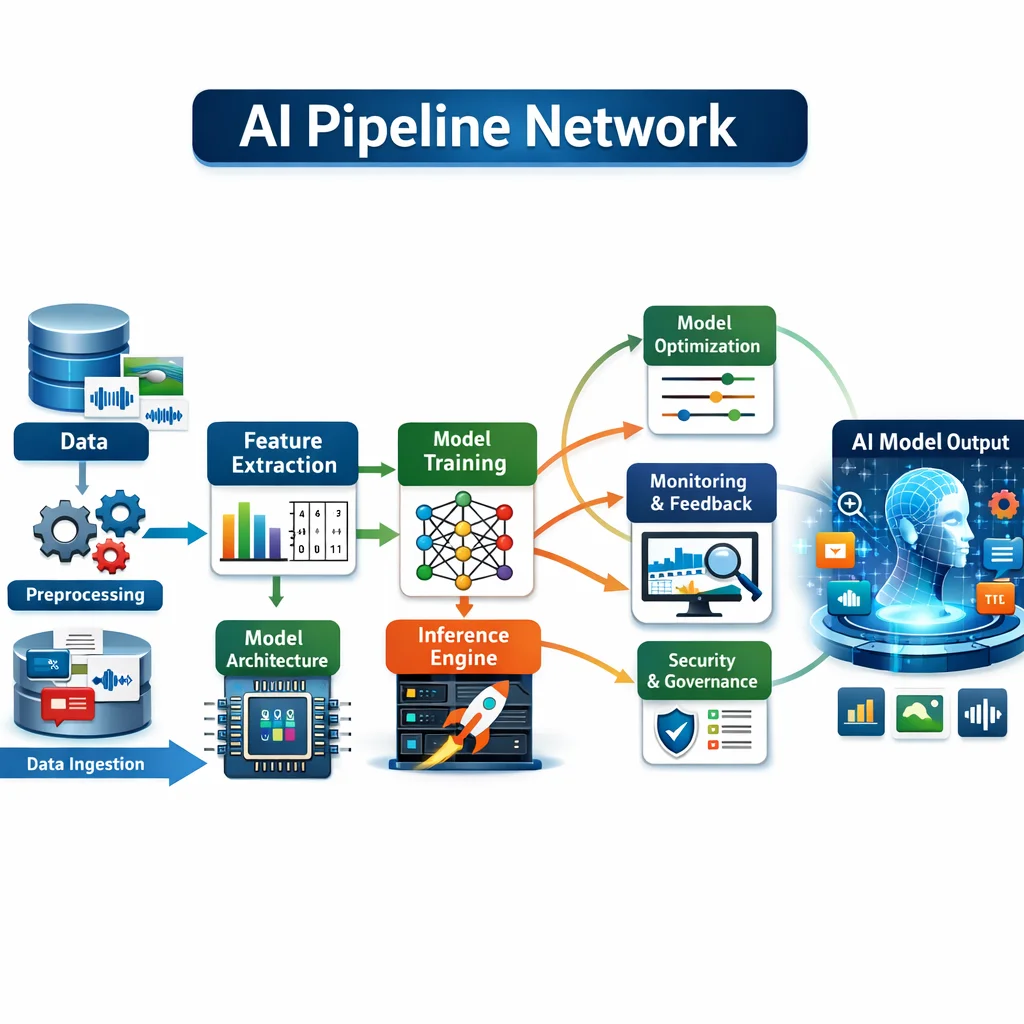
Ollama, llama.cpp, and vLLM for high-performance local AI inference with GPU acceleration. Supports models from 7B to 70B parameters with quantization for optimal memory utilization.
PostgreSQL, Redis Stack, Neo4j, ClickHouse, and MinIO for comprehensive data management spanning relational, graph, time-series, and object storage needs.
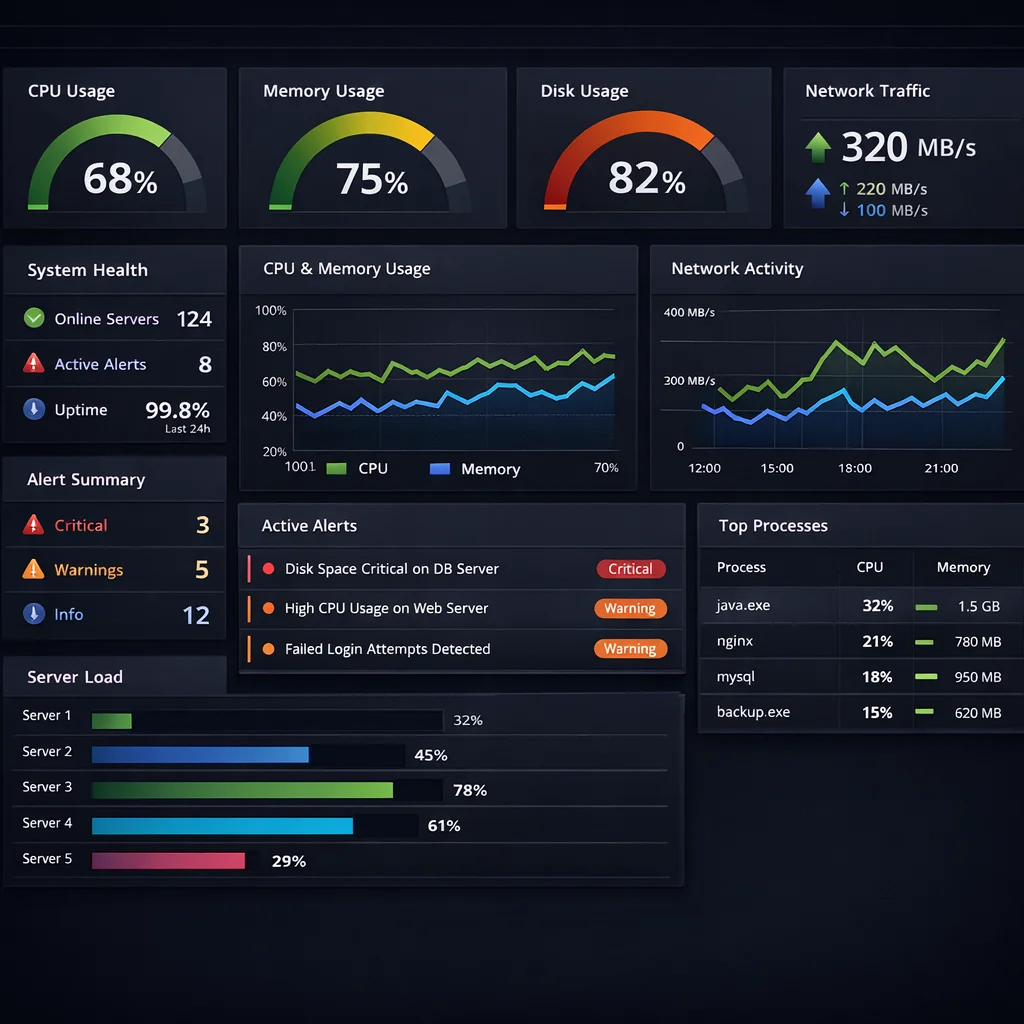
Prometheus metrics collection, Grafana dashboards, Loki log aggregation, and Jaeger distributed tracing provide complete visibility into system health and performance.
1Password Connect integration with automated credential injection into Docker containers. Zero hardcoded secrets with comprehensive audit trails for compliance.
ChromaDB vector storage with web crawling, document parsing, and embedding generation for retrieval-augmented generation across internal knowledge bases.
Traefik reverse proxy with automatic TLS and Tailscale mesh VPN for zero-trust remote access to all services without exposing ports to the public internet.
Every layer of the stack is containerized with Docker Compose, managed through Portainer, and secured behind Traefik with automatic TLS certificate rotation and intelligent routing rules.
Docker Compose manifests define the complete service topology with health checks, resource limits, restart policies, and dependency ordering. Portainer provides a web-based management interface for monitoring container status, viewing logs, and performing rolling updates without SSH access. Each service category — AI inference, databases, monitoring, and networking — lives in its own compose stack with shared Docker networks enabling secure inter-service communication.
Traefik serves as the edge router, handling SSL termination, automatic Let's Encrypt certificate renewal, and intelligent request routing based on hostname and path rules. Tailscale provides a zero-configuration mesh VPN that enables secure remote access to any service without exposing ports to the public internet. The combination delivers enterprise-grade networking without the complexity of traditional VPN appliances or firewall rule management.
On-premise AI stack eliminates recurring API and compute costs while maintaining full control over data, models, and inference performance. The hardware investment reaches ROI within 12 months compared to equivalent cloud infrastructure running comparable GPU instances. Every dollar saved on cloud compute is reinvested into expanding model capabilities, adding storage capacity, or scaling to additional deployment sites.
Full-stack monitoring with distributed tracing, log aggregation, and real-time alerting. Grafana dashboards provide instant visibility into GPU utilization, model latency, and database performance.
1Password Connect Server integration with automated injection into deployment workflows. Comprehensive audit trails satisfy SOC 2 and compliance requirements without manual credential rotation.
Comprehensive operational documentation and verification tooling for reliable day-2 operations. Every service includes health check scripts, backup procedures, and disaster recovery playbooks. New team members can deploy, troubleshoot, and restore any service within hours rather than weeks, reducing operational risk and knowledge concentration.
Proven infrastructure with extensive automation, monitoring, and operational tooling across the entire stack delivering measurable business outcomes.
Annual cloud costs eliminated
CPU threads for parallel workloads
NFS model storage shared across nodes
Private network backbone speed
Deployment, backup, and verification automation
Alerting and observability configuration
RAG pipeline and indexing utilities
OpenAI-compatible API gateway
Hardening and audit documentation
Service stack manifests and configs
Internal network topology details, IP addresses, credentials, and service hostnames are intentionally omitted from all public-facing documentation and marketing materials. Full operational runbooks, architectural diagrams, and security audit reports are available for authorized personnel and qualified investors under NDA upon request.
This infrastructure pattern applies to any organization running AI workloads that require data sovereignty, predictable costs, and enterprise-grade reliability without cloud vendor lock-in.
Healthcare, financial services, and government agencies that require data residency guarantees and audit trails. On-premise AI inference means sensitive data never leaves the controlled environment while maintaining full compliance with HIPAA, SOC 2, and FedRAMP requirements.
Companies building AI products that need to iterate rapidly on model selection and fine-tuning without per-token API costs eating into runway. The pluggable inference layer supports hot-swapping between Ollama, llama.cpp, and vLLM backends as model requirements evolve from prototype to production scale.
Academic and corporate research groups that need GPU compute for experiments without competing for shared cloud resources or waiting for quota approvals. Dedicated hardware with full root access enables rapid prototyping of novel architectures, dataset processing, and model evaluation pipelines.
Learn how we can build enterprise AI/ML infrastructure for your organization.