Opportunity Signal Intelligence Engine

Proprietary AI pipeline that autonomously discovers, analyzes, and scores business opportunities from public web sources using multi-channel scraping, local Qwen 30B inference, and ChromaDB vector storage — delivering institutional-grade market intelligence at zero marginal cost per query with RAG-based semantic retrieval.

$0
Per-Query API Cost
5
Scoring Dimensions
RAG
Semantic Retrieval
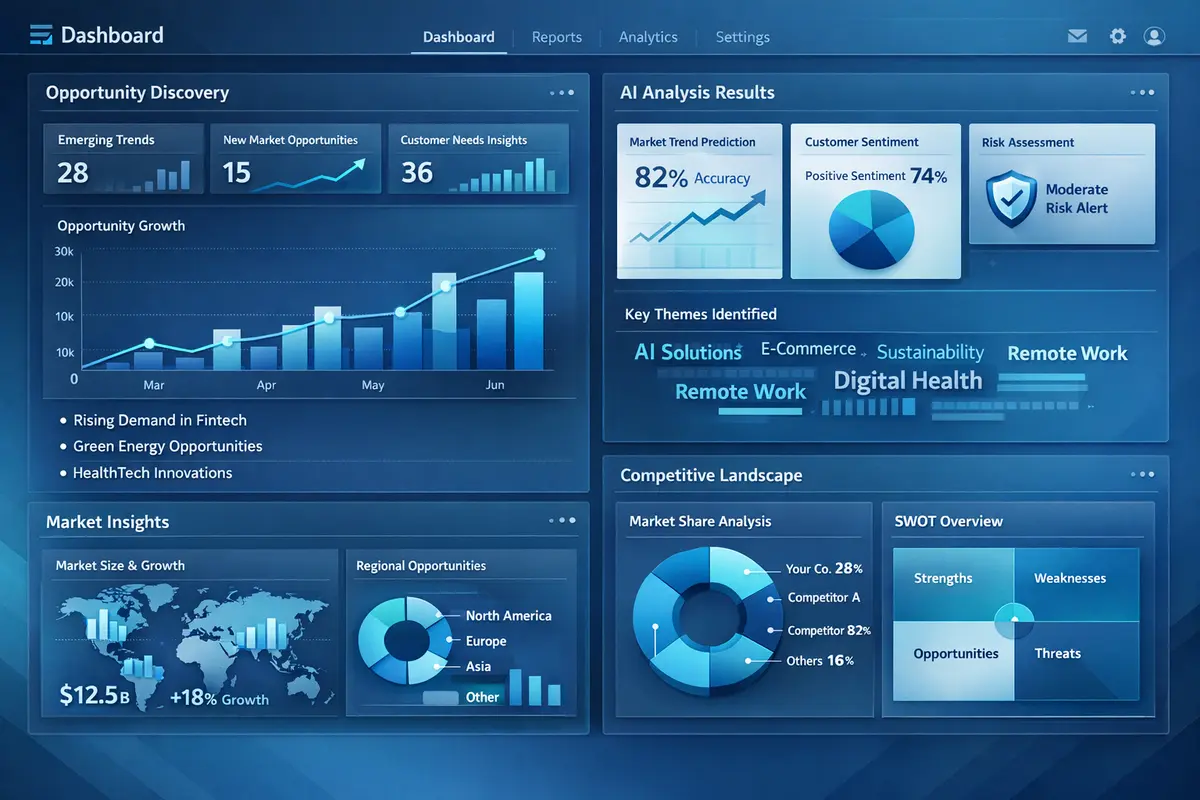
AI market intelligence engine dashboard showing real-time deal scoring and opportunity pipeline

Investor Summary

Opportunity discovery is noisy and time-intensive. Manual research across forums, marketplaces, and community platforms consumes 15-20 hours per week for a single analyst, and the signal-to-noise ratio deteriorates as information volume grows. This system automates the entire sourcing and analysis workflow across multiple channels, scores each opportunity against a structured rubric using local LLM inference, and stores results in a semantic search database for rapid filtering and decision support.

The $50B+ market intelligence industry relies on expensive subscription services and manual analyst work. Platforms like PitchBook, CB Insights, and Crunchbase charge $20,000-$50,000 per year for curated deal flow data that is available to every competitor simultaneously. By running local LLM inference on a Qwen 30B model via llama.cpp on dedicated GPU hardware, our pipeline eliminates per-query API costs entirely while delivering analysis quality that matches or exceeds cloud-based alternatives. Every discovered opportunity is embedded as a high-dimensional vector and stored in ChromaDB for instant semantic retrieval, enabling analysts to query the entire opportunity corpus in natural language rather than relying on rigid keyword filters or manually maintained spreadsheets.

The pipeline ingests signals from Reddit communities (via the PRAW API), Indie Hackers discussion forums (via BeautifulSoup scraping), and targeted Google dorking queries on a configurable cron schedule. Each raw signal passes through a multi-stage processing pipeline that includes text normalization, entity extraction, deduplication against the existing corpus, and structured scoring across five dimensions. The resulting intelligence database compounds in value with every ingestion cycle, as historical trend analysis reveals emerging patterns that are invisible to point-in-time research. A personalization layer enables FICO-based deal matching, surfacing opportunities aligned with available financing capacity for credit-aware decision making.

Professional celebrating a job match notification on her smartphone

Product Capabilities

  • Multi-source scrapers for Reddit (PRAW), Indie Hackers (BeautifulSoup), and Google dorking with configurable queries
  • Local LLM analysis pipeline with five-dimension structured scoring methodology running on Qwen 30B
  • ChromaDB-based semantic search with sentence transformer embeddings and metadata filtering
  • Production, demo, and personalization pipelines with FICO-based credit-aware deal matching
  • Cron automation and setup scripts for fully hands-off operation with health monitoring
  • Deduplication engine that prevents redundant analysis of previously seen opportunities
  • Natural language query interface over the full opportunity corpus with ranked result retrieval

Deep Dive: The RAG Pipeline Architecture

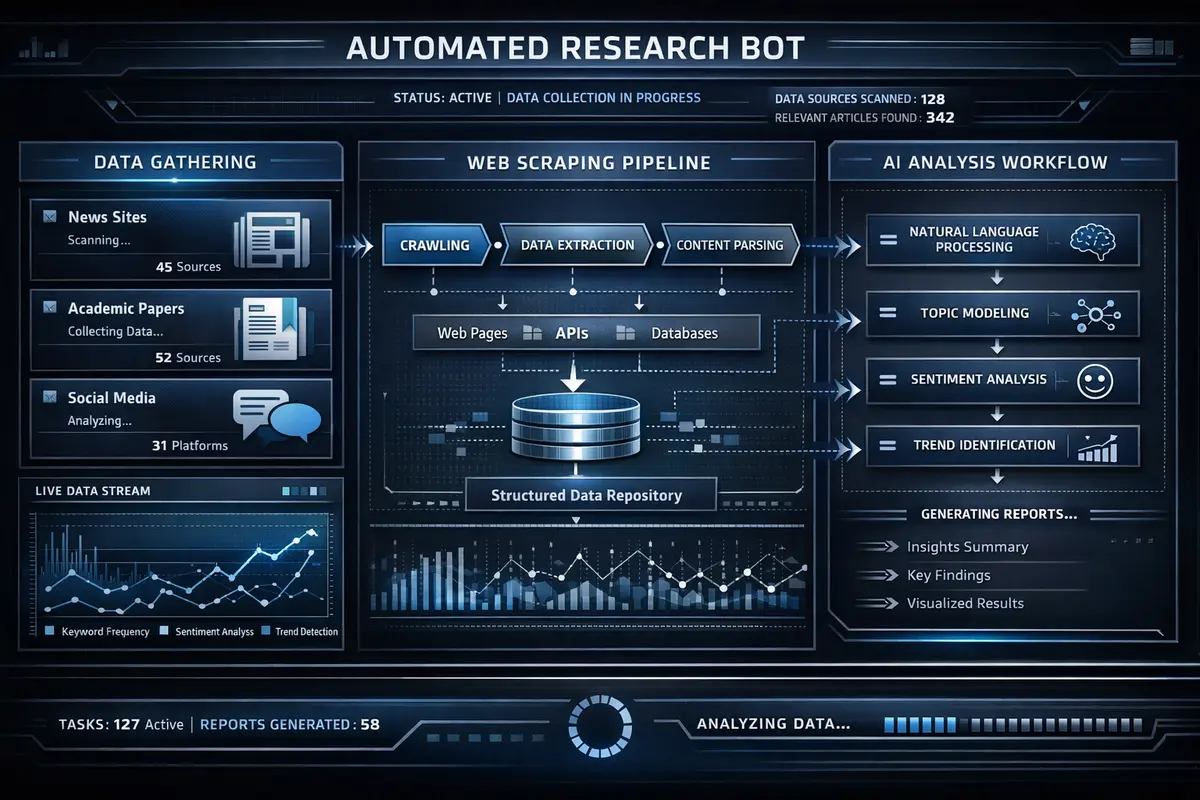
Our Retrieval-Augmented Generation architecture transforms raw web signals into structured, queryable market intelligence through a multi-stage processing pipeline that handles ingestion, normalization, analysis, embedding, and retrieval.

RAG pipeline architecture diagram showing the complete data flow from multi-source ingestion through embedding generation to semantic retrieval

Multi-Source Ingestion Layer

The pipeline begins with parallel multi-source ingestion. A custom Reddit scraper built on the PRAW (Python Reddit API Wrapper) library monitors configurable subreddits including r/SideProject, r/Entrepreneur, r/SaaS, r/microsaas, and r/startups. The scraper respects Reddit's rate limits through exponential backoff and maintains a persistent seen-post cache to avoid re-processing content across ingestion cycles. For each post, the scraper captures the title, body text, comment threads above a configurable karma threshold, author metadata, and engagement metrics including upvote ratio and comment velocity.

The Indie Hackers scraper uses BeautifulSoup to parse discussion threads, milestone posts, and product launch announcements. Because Indie Hackers does not provide a public API, the scraper implements session management with rotating user agents and request throttling to maintain reliable access. Google dorking queries are constructed from templates that combine industry-specific keywords with site operators, date ranges, and content type filters to surface early-stage signals that traditional market research tools miss entirely.

Raw text from each source passes through a preprocessing stage that normalizes formatting, strips HTML entities, extracts named entities (company names, product names, revenue figures, user counts), and removes noise including boilerplate footer text, moderator notices, and duplicate content fragments. The deduplication engine computes locality-sensitive hashes of each opportunity to prevent redundant analysis when the same opportunity surfaces across multiple channels or in subsequent scrape cycles.

LLM Analysis and Scoring Pipeline

Cleaned and deduplicated content is forwarded to the local Qwen 30B language model running on dedicated GPU hardware via llama.cpp. The model receives each opportunity as a structured prompt that includes the source text, extracted entities, and engagement metrics, along with a detailed scoring rubric that ensures consistent evaluation methodology across every opportunity regardless of source channel or content format.

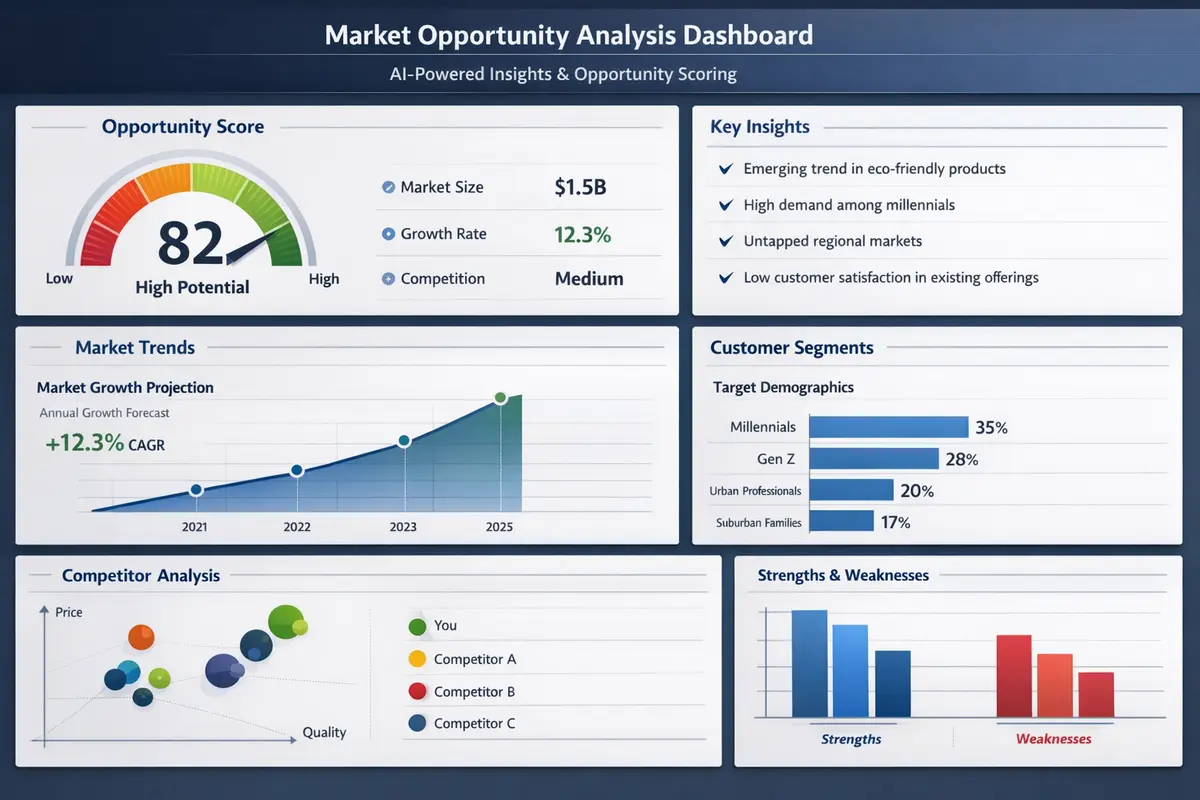
The scoring rubric evaluates each opportunity across five weighted dimensions. Addressable market size receives the highest weight, estimated through the LLM's analysis of the target customer segment, pricing potential, and total available market indicators present in the source material. Competitive landscape density measures the number and strength of existing solutions serving the same need. Technical barrier to entry assesses the engineering complexity required to build a viable product. Estimated time-to-first-revenue captures how quickly the opportunity can generate cash flow. Automation potential evaluates whether the business model supports scalable, low-touch operations. Each dimension receives a score from 1-10, and the weighted composite determines the opportunity's priority ranking in the database.

The LLM also generates a structured summary for each opportunity that includes a one-paragraph description, a bulleted list of key strengths and risks, comparable companies or products, and suggested next steps for further evaluation. This structured output is parsed into discrete fields and stored alongside the raw scores in ChromaDB, enabling both numeric filtering and free-text search over the analysis narratives.

Deal scoring dashboard showing multi-dimensional opportunity analysis with radar charts and composite rankings

System Architecture

Recruiting team collaborating around a touchscreen display
🔎

Multi-Source Ingestion

Web Scraping Layer

Automated scraping from Reddit via PRAW, Indie Hackers via BeautifulSoup, and custom Google dorking queries with configurable frequency and source targeting. Each scraper implements rate limiting, session management, and persistent caching to maintain reliable, respectful access to source platforms. New sources can be added by implementing a standard scraper interface that outputs normalized opportunity documents.

🤖

Local LLM Analysis

Qwen 30B Inference

Structured opportunity scoring using Qwen 30B running locally via llama.cpp on dedicated GPU hardware. Zero API costs, full data privacy, and consistent five-dimension scoring methodology across every discovered opportunity. The model produces both numeric scores and narrative summaries that are parsed into structured fields for downstream filtering and search.

🗃

RAG-Based Retrieval

ChromaDB Vector Search

Each scored opportunity is embedded using sentence transformers and stored in ChromaDB with rich metadata including source channel, ingestion timestamp, composite score, and individual dimension scores. Semantic similarity search enables natural language queries like "passive income SaaS with low competition" to return conceptually relevant results even when those exact phrases never appear in source material.

Deep Dive: Vector Storage and Semantic Retrieval

ChromaDB serves as the persistent intelligence layer, enabling both programmatic filtering and natural language exploration of the entire opportunity corpus with sub-second query latency.

Embedding and Indexing Strategy

Each scored opportunity is converted into a high-dimensional embedding vector using sentence transformers (all-MiniLM-L6-v2 for optimal speed-quality balance, with optional upgrade to BGE-large for higher recall on specialized queries). The embedding captures the semantic meaning of the opportunity's description, market analysis, and competitive assessment in a dense vector representation that enables similarity search across concepts rather than exact keyword matches. ChromaDB indexes these vectors using HNSW (Hierarchical Navigable Small World) graphs, delivering approximate nearest-neighbor search with sub-millisecond latency even as the corpus grows to hundreds of thousands of documents.

Alongside the embedding vector, ChromaDB stores structured metadata for each opportunity including the source channel, ingestion timestamp, composite score, individual dimension scores, extracted entity tags, and the full LLM-generated analysis narrative. This dual storage model enables hybrid queries that combine semantic similarity with metadata filters. An analyst can search for "B2B SaaS tools for accountants" while simultaneously filtering for opportunities with a market size score above 7 and a competitive density score below 4, narrowing results to high-potential, low-competition niches.

Personalization and Credit-Aware Matching

The personalization pipeline introduces a user profile layer that adjusts opportunity rankings based on individual capabilities and constraints. For credit-aware deal matching, the system accepts a FICO score range and available capital parameters, then re-weights opportunities to prioritize those with startup costs, financing requirements, and cash flow timelines compatible with the user's financial profile. This transforms the platform from a generic intelligence feed into a personalized deal flow engine that surfaces actionable opportunities tailored to the specific user's ability to execute.

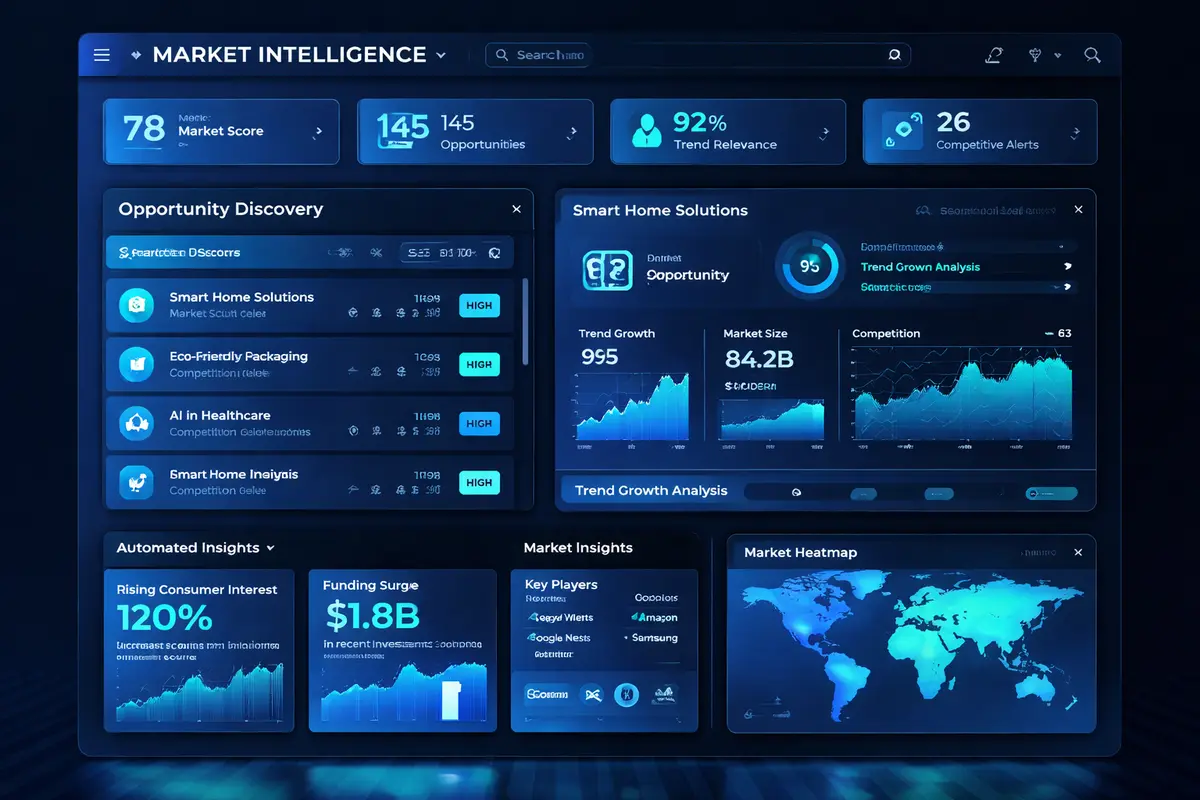
ChromaDB semantic search interface showing natural language queries returning ranked opportunity results with metadata overlays

Technology Stack

Python PRAW BeautifulSoup Requests ChromaDB Qwen 30B llama.cpp Sentence Transformers RAG Pipeline Vector Database Cron Automation HNSW Indexing

Differentiation and Moat

Multi-Source Consistency

Every opportunity passes through the same five-dimension scoring rubric regardless of source channel, enabling apples-to-apples comparison across Reddit threads, Indie Hackers posts, and dorked web pages. This normalization eliminates the source bias that plagues manual research where analysts unconsciously weight familiar channels more heavily.

Zero Marginal API Cost

Local LLM inference via Qwen 30B on llama.cpp eliminates ongoing per-query API expenditure and removes third-party dependency on OpenAI, Anthropic, or any cloud provider. The one-time hardware investment yields unlimited analysis capacity with complete data sovereignty and no vendor lock-in risk.

Compounding Intelligence

The ChromaDB corpus grows more valuable with every ingestion cycle. Historical trend analysis reveals emerging patterns across sectors, semantic search quality improves as the embedding space fills with diverse examples, and time-series analysis of scoring distributions exposes market shifts before they surface in mainstream research platforms.

Results and Impact

Measurable outcomes demonstrating the platform's value in reducing research overhead, eliminating API costs, and accelerating decision velocity across deal sourcing and market intelligence workflows.

20hrs

Weekly research time eliminated per analyst

$0

Marginal cost per analyzed opportunity

3+

Source channels monitored continuously

<1s

Semantic search query latency

The pipeline runs autonomously on a configurable cron schedule, continuously building a growing corpus of scored opportunities without human intervention. Manual opportunity research that previously required 15-20 hours per week of analyst time is fully automated. Comparable cloud-based LLM analysis at the same throughput would cost $0.03-0.10 per opportunity through OpenAI or Anthropic APIs, creating significant cost at scale. The local inference approach eliminates this expenditure entirely while maintaining full data sovereignty. The compounding intelligence effect means that every week of operation makes the platform more valuable, as historical trend analysis reveals emerging market patterns and semantic search quality improves with corpus diversity.

Semantic search interface showing natural language opportunity queries with ranked results and trend analytics

Commercial Use Cases

Applicable across venture capital deal sourcing, corporate strategy research, competitive intelligence, and entrepreneurial opportunity validation workflows.

Deal Sourcing and Venture Capital

Automated opportunity discovery for venture capital and private equity firms seeking early-stage signals before they reach mainstream deal platforms. The pipeline surfaces emerging trends from community discussions weeks or months before they appear in curated databases like PitchBook or Crunchbase, providing a genuine information advantage for early-stage deal sourcing.

Market Intelligence and Strategy

Internal research and competitive analysis for strategic planning teams who need continuous monitoring of emerging market dynamics without per-seat subscription costs. The semantic search interface enables strategy teams to explore market shifts, identify emerging competitors, and validate strategic hypotheses against a continuously updated intelligence corpus.

Product Ideation and Validation

Trend analysis and opportunity validation for founders and product teams seeking data-driven confirmation of new business concepts. The scoring methodology provides an objective assessment of market potential that reduces reliance on intuition and anecdotal evidence, while historical corpus analysis reveals whether an opportunity represents a growing trend or a fading signal.

Evidence of Execution

production_opportunity_pipeline.py

Main pipeline entrypoint with full orchestration logic

scrapers/

Source scrapers with configs and rate-limited handlers

data/

ChromaDB collections, embedding cache, and dedup index

query_opportunities.py

Semantic search interface with hybrid filtering

setup_*.sh

Cron automation, environment setup, and health checks

ARCHITECTURE.md

System design documentation and data flow diagrams

Interested in This Solution?

Learn how we can build custom AI market intelligence systems tailored to your organization's deal sourcing and research workflows.

Schedule a Demo View All Projects

In Action

Professional celebrating a job match notification on her smartphone
Recruiting team collaborating around a touchscreen display
Developer coding an AI chatbot interface late at night