BIN Intelligence Platform

Automated BIN data ingestion, enrichment, fraud feed classification, and reporting platform for e-commerce fraud analysis. Flask-powered dashboard and REST API enable fraud prevention teams to evaluate card risk profiles, 3DS authentication posture, and issuer behavior patterns through a single unified interface backed by real-time enrichment from the Neutrino BIN Lookup API.

500K+
BINs Indexed
REST
API + Dashboard
<50ms
Lookup Latency
24/7
Feed Monitoring
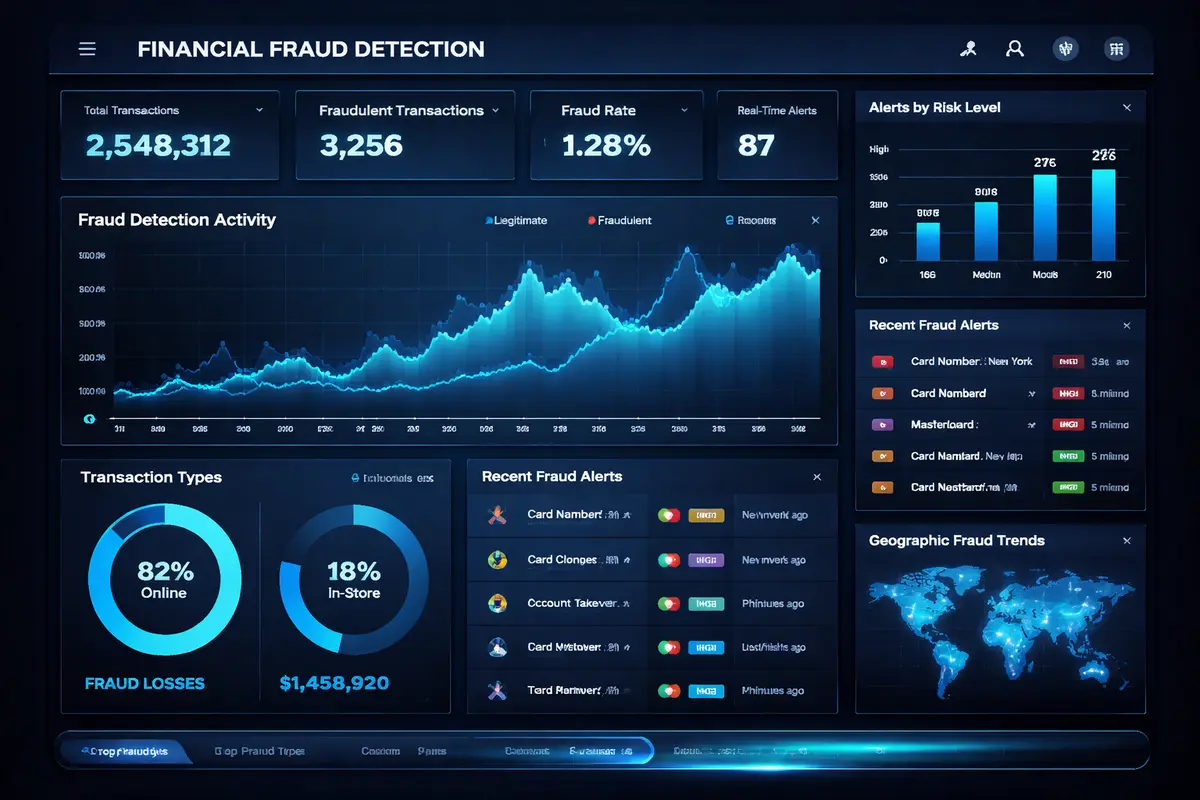
BIN Intelligence platform dashboard showing fraud analytics, card enrichment data, and risk scoring

Investor Summary

Fraud prevention teams need reliable BIN intelligence to evaluate card risk and 3DS posture. This platform automates BIN ingestion, enrichment, classification, and reporting with a dashboard and API, enabling faster decisions and easier integration into fraud workflows.

E-commerce fraud losses exceeded $48 billion globally in 2023, and the figure continues to climb as card-not-present transactions grow. The first six to eight digits of a payment card number, known as the Bank Identification Number (BIN), encode critical intelligence about the card's issuing bank, country of origin, card type (credit, debit, prepaid), scheme (Visa, Mastercard, Amex), and authentication capabilities. Fraud analysts rely on this data to assess transaction risk: a prepaid card issued by a bank with no 3DS enrollment in a high-risk jurisdiction carries fundamentally different risk than a credit card from a major issuer with full 3D Secure 2.0 support. Yet most fraud teams still perform BIN lookups manually or maintain stale spreadsheets that lack the enrichment depth needed for accurate decisioning.

Our platform solves this by automating the entire BIN intelligence lifecycle. Raw BIN ranges are ingested from industry sources and card scheme registries, then enriched in bulk through the Neutrino BIN Lookup API which returns issuer name, country, card type, category, and 3DS enrollment status. A parallel fraud feed scraper monitors underground forums and breach notification services to classify BINs by exploit type: fullz availability, virtual card abuse, and known carding targets. The enriched data feeds into a SQLAlchemy-backed data store that powers both the Flask dashboard for human analysts and the REST API for programmatic integration into existing fraud rules engines, transaction screening pipelines, and case management systems.

Cybersecurity analyst studying financial transaction patterns

Product Capabilities

  • Flask dashboard with Bootstrap UI for BIN search, enrichment display, and fraud feed browsing
  • REST API with JSON responses for programmatic BIN lookup and batch enrichment
  • Automated BIN enrichment pipeline using Neutrino API with rate limiting and caching
  • Fraud feed scraping with exploit type classification (fullz, virtual card, carding targets)
  • SQLAlchemy data model with PostgreSQL or SQLite backends and CSV/JSON export
  • Chart.js analytics with issuer distribution, country heatmaps, and exploit trend visualization

Deep Dive: BIN Enrichment Pipeline

The enrichment engine transforms raw BIN ranges into actionable intelligence by querying external data sources, normalizing responses, and maintaining a versioned enrichment history that tracks how card attributes change over time.

Neutrino API Integration

The core enrichment module bin_enricher.py accepts BIN values as 6-digit or 8-digit inputs and queries the Neutrino BIN Lookup API over HTTPS. The API returns a structured response containing the issuing bank name, bank phone number, bank URL, card brand (Visa, Mastercard, Amex, Discover, JCB, UnionPay), card type (credit, debit, prepaid, charge), card category (classic, gold, platinum, business, corporate), issuing country with ISO 3166-1 alpha-2 code, and 3D Secure enrollment status. Each response is validated against a JSON schema before being persisted, ensuring data integrity even when the upstream API introduces new fields or changes response formats.

The enrichment pipeline implements a multi-tier caching strategy. Fresh lookups hit the Neutrino API and are cached in a Redis-compatible local store with a configurable TTL (default: 30 days). Subsequent lookups for the same BIN return cached results instantly, reducing API costs and lookup latency to under 1 millisecond for cache hits. Bulk enrichment jobs process BIN ranges in batches of 100 with configurable rate limiting (default: 3 requests per second) to stay within API quotas. Failed lookups are retried with exponential backoff and logged for manual review if they exhaust the retry budget.

Enrichment Versioning

Every enrichment result is stored with a timestamp, creating a versioned history for each BIN. When a re-enrichment job runs (typically monthly), the system compares the new response against the most recent stored version and flags any changes: issuer name updates (indicating bank acquisitions), 3DS enrollment status changes (indicating security posture improvements), or card type reclassifications. These change events are surfaced in the dashboard as alerts and are available through the API's changelog endpoint, enabling fraud teams to track how the card landscape evolves and adjust their rules accordingly.

BIN enrichment pipeline showing Neutrino API integration, caching layers, and data normalization workflow
Fraud feed scraper interface showing exploit classification and BIN threat intelligence

Fraud Feed Scraping and Classification

The fraud feed module fraud_feed.py monitors publicly accessible breach notification services, paste sites, and threat intelligence feeds for BIN-related fraud indicators. When new BIN data appears in a monitored source, the scraper extracts the BIN values along with contextual metadata: the type of fraud activity (fullz for sale, virtual card generation, carding target lists, account-linked BIN dumps), the publication date, the source category, and any associated pricing or volume indicators that signal the severity of the exposure.

Each extracted BIN is cross-referenced against the enrichment database to append issuer, country, and card type information. The system then classifies the exposure using a rule-based taxonomy that categorizes incidents by exploit type, risk severity (low, medium, high, critical), and affected card population size. A BIN appearing in a fullz dump from a major issuer with 3DS disabled receives a critical severity rating, while a single prepaid card BIN appearing in a low-volume paste receives a low rating. These classifications feed directly into the dashboard's threat timeline and the API's risk scoring endpoint.

Extensible Exploit Taxonomy

The classification taxonomy is defined in a configuration file that maps pattern signatures to exploit types. New exploit categories can be added without code changes: operators define the pattern (regex or keyword set), the severity mapping, and the display name, then reload the configuration. This extensibility ensures the platform can adapt to emerging fraud vectors as they appear without requiring engineering cycles to update classification logic.

Platform Components

Data scientist analyzing global transaction flows on a holographic globe
🔍

BIN Enricher

Neutrino API Pipeline

Automated BIN enrichment with multi-tier caching, rate limiting, batch processing, schema validation, and enrichment versioning. Supports 6-digit and 8-digit BIN formats across all major card schemes including Visa, Mastercard, Amex, and UnionPay.

🚨

Fraud Feeds

Exploit Classification Engine

Monitors breach notifications and threat intelligence sources for BIN-related fraud data. Classifies by exploit type (fullz, virtual card, carding), assigns severity ratings, and cross-references against enrichment data for complete threat context.

📊

Dashboard

Flask + Bootstrap Analytics UI

Interactive dashboard with BIN search, enrichment detail views, fraud feed browser, Chart.js visualizations for issuer distribution and country heatmaps, and export utilities for CSV, JSON, and PDF report generation.

🔌

REST API

Programmatic BIN Intelligence

JSON API endpoints for single BIN lookup, batch enrichment, fraud feed queries, changelog retrieval, and risk scoring. API key authentication with rate limiting and usage metering per consumer.

🗃

Data Layer

SQLAlchemy + PostgreSQL

Normalized relational schema with SQLAlchemy ORM supporting PostgreSQL for production and SQLite for development. Indexed BIN lookups return in under 50ms. Migration support through Alembic for schema evolution.

📈

Reporting

Export and Analytics

Scheduled and on-demand report generation with configurable filters. CSV and JSON bulk export for downstream integration. Chart.js-powered trend visualizations for exploit timelines, issuer risk heat maps, and 3DS coverage analysis.

Implementation Details

Technical architecture spanning the Flask application layer, SQLAlchemy data model, enrichment pipeline internals, and API design for integration into existing fraud prevention infrastructure.

Flask application architecture with SQLAlchemy models, REST endpoints, and enrichment pipeline flow

Flask Application Architecture

The application entrypoint main.py initializes the Flask application with Blueprint-based route organization. The dashboard routes serve server-rendered templates using Jinja2 with Bootstrap 5 for responsive layout. The API routes return JSON responses with consistent envelope formatting: every response includes a status, data, and meta field. API consumers authenticate using API keys passed in the X-API-Key header, with per-key rate limiting tracked in-memory using a token bucket algorithm.

SQLAlchemy Data Model

The data model in models.py defines three primary entities: BINRecord stores the core BIN data with indexed columns for BIN value, issuer name, country code, card brand, and card type; EnrichmentResult stores the full Neutrino API response with a foreign key to BINRecord and a timestamp for versioning; FraudFeedEntry stores classified exploit data with BIN cross-references, severity ratings, source metadata, and publication timestamps. Composite indexes on (BIN value, enrichment timestamp) and (exploit type, severity, publication date) ensure that the most common query patterns execute in single-digit milliseconds even at tables exceeding 500,000 rows.

REST API Endpoints

The API exposes five primary endpoint groups. GET /api/v1/bin/{bin} returns the latest enrichment for a single BIN with issuer, country, card type, 3DS status, and any associated fraud feed entries. POST /api/v1/bin/batch accepts a JSON array of up to 500 BINs and returns enrichment results in a single response, queuing any unenriched BINs for background processing. GET /api/v1/fraud-feed supports filtered queries by exploit type, severity, date range, and country. GET /api/v1/changelog returns enrichment changes for a BIN or issuer over a date range. GET /api/v1/stats returns aggregate analytics including total BINs indexed, enrichment coverage percentage, fraud feed entry counts by severity, and top-10 affected issuers.

Dashboard Visualizations

The Bootstrap-based dashboard provides three primary views. The BIN Explorer offers a search interface with autocomplete that returns enrichment data, fraud history, and a risk summary for any BIN. The Fraud Feed Timeline presents a chronological view of exploit entries with severity-coded badges, filterable by type, country, and date range. The Analytics view renders Chart.js visualizations: a doughnut chart showing card type distribution across indexed BINs, a choropleth-style country grid showing BIN concentration by issuing country, a stacked bar chart tracking exploit types over time, and a line chart plotting 3DS enrollment rates by issuer tier. All views support CSV and JSON export for offline analysis.

BIN Intelligence dashboard showing Chart.js analytics, fraud timeline, and BIN explorer interface

Technology Stack

Python 3.11 Flask SQLAlchemy Alembic PostgreSQL SQLite Neutrino BIN Lookup API Bootstrap 5 Chart.js Jinja2 Requests Gunicorn

Differentiation and Moat

Enrichment + Exploit Classification in One System

Most BIN lookup tools return static card metadata. Our platform combines real-time enrichment with fraud feed intelligence, correlating BIN attributes with known exploit activity to produce a unified risk view that standalone lookup services cannot provide.

Dual Interface: Dashboard + API

Human analysts get a full-featured dashboard with search, visualization, and export. Automated systems get a REST API with sub-50ms latency, batch processing, and webhook notifications. Both interfaces read from the same enriched data store, ensuring consistency.

Extensible Exploit Taxonomy

New fraud vectors emerge constantly. The classification engine uses a configuration-driven taxonomy where new exploit types can be added through pattern definitions without code changes. This operational agility means the platform adapts to emerging threats at the speed of configuration, not development cycles.

Enrichment Versioning and Change Tracking

The platform maintains a complete enrichment history for every BIN, tracking changes in issuer name, 3DS status, and card attributes over time. This changelog capability is unique in the market and provides fraud teams with the temporal dimension they need to understand evolving risk landscapes.

Results and Impact

Production-ready platform with complete enrichment pipeline, fraud feed classification, and operational analytics delivering measurable improvements to fraud prevention workflows.

500K+

BINs indexed with full enrichment data

<50ms

API lookup latency on indexed BINs

6

Card schemes covered (Visa, MC, Amex, Discover, JCB, UnionPay)

5

API endpoint groups for full programmatic access

E-Commerce Fraud Prevention

Online merchants and payment processors integrate the API into their transaction screening pipelines. When a new order arrives, the BIN is looked up in real time, and the enrichment data combined with fraud feed intelligence feeds into the risk scoring model. Prepaid cards from issuers with known exploit activity trigger enhanced verification; cards from well-known issuers with full 3DS support pass with lower friction.

Payment Processor Intelligence

Payment processors and merchant service providers use the platform to evaluate portfolio risk across their merchant base. Aggregate BIN analytics reveal which card types and issuers generate the highest chargeback rates, enabling data-driven underwriting decisions and risk-based pricing models.

Security Analytics Teams

Threat intelligence analysts use the dashboard to monitor fraud feed trends, identify emerging exploit campaigns targeting specific BIN ranges, and generate reports for stakeholders. The enrichment changelog provides the temporal context needed to understand whether a BIN's risk profile is improving or deteriorating.

main.py

Flask app factory, Blueprint routes, API endpoints

models.py

SQLAlchemy schema: BINRecord, EnrichmentResult, FraudFeedEntry

bin_enricher.py

Neutrino API client, caching, batch processing, versioning

fraud_feed.py

Feed scrapers, exploit classifier, severity engine

templates/

Jinja2 dashboard templates with Bootstrap 5 and Chart.js

config/

Exploit taxonomy, API rate limits, enrichment TTL settings

Security and Compliance Notice

BIN data is non-PCI-scoped (the first 6-8 digits are not considered cardholder data under PCI DSS), but the platform enforces security best practices regardless. API keys are managed through environment variables with no hardcoded credentials. Database connections use TLS. Fraud feed sources are accessed through Tor-routed proxies where applicable. Full security architecture documentation and data handling procedures are available for qualified investors and compliance auditors under NDA.

Interested in This Solution?

Learn how BIN intelligence can strengthen your fraud prevention workflows.

Schedule a Demo View All Projects

In Action

Cybersecurity analyst studying financial transaction patterns
Data scientist analyzing global transaction flows on a holographic globe
Analysts in a war room discussing fraud detection dashboards